


We Visited Claypaky HQ and Previewed the New B-EYE K30 FX
By the time a lighting fixture comes out of a road case, we usually have a job for it. We patch it, start building looks, and figure out how to get the most out of it. What we rarely see is the work that made those possibilities available in the first place. Earlier this fall, we headed to Bergamo, Italy, to visit Claypaky’s headquarters. With the company celebrating 50 years in 2026, it was a it was a great time to learn about where the company came from and where it is headed.
Fifty Years of Claypaky
Pasquale “Paky” Quadri founded Claypaky in the province of Bergamo in 1976. Its early roots were in disco lighting, followed by the scanners and moving heads that helped build its international reputation.

That history includes some very familiar names. Sharpy helped popularize the compact, narrow beam fixture and the dense arrays of light that became such a recognizable part of concert production. B-EYE combined wash and beam duties with a face full of effects possibilities. XTYLOS took another route, building a moving head around an RGB laser source. The industry recognized those ideas along the way. Sharpy earned a PLASA Award for Innovation in 2010, followed by the B-EYE K20 in 2013. XTYLOS won LDI’s Best Debuting Product award in the lighting fixture category in 2019.
A Museum for Show Lighting
Claypaky has given that history a home at its headquarters. The Museum of Modern Show Lighting, or MoMS, was conceived by Quadri and opened in 2015. It follows the development of entertainment lighting, including the effects that filled dance floors in the 1970s and ’80s and the increasingly complex automated fixtures that followed.
If you have ever paused a concert video to figure out what fixtures were in the rig, this is an easy place to lose track of time.
One of the best parts is that the collection extends beyond Claypaky’s own products. Seeing equipment from across the industry makes the story much more interesting. You can follow how different manufacturers approached the same creative challenges, and how those ideas became tools that designers and programmers now take for granted.
Looking at earlier generations of effects and moving lights also puts familiar programming choices in context. Movement, patterns, and changes in color have been entertaining audiences for decades. The hardware, and the amount of control we have over it, have kept evolving.

Inside the Claypaky Showroom
The showroom puts that history alongside the latest fixtures. With so much of the Claypaky range in one room, there is plenty to test and experiment with. A space like this lets you spend time with the questions that matter when choosing a fixture. How does the beam look as you change its size? What happens when you start combining effects? How would it sit alongside the other lights in your design? Having the equipment in front of you makes those conversations much more useful.
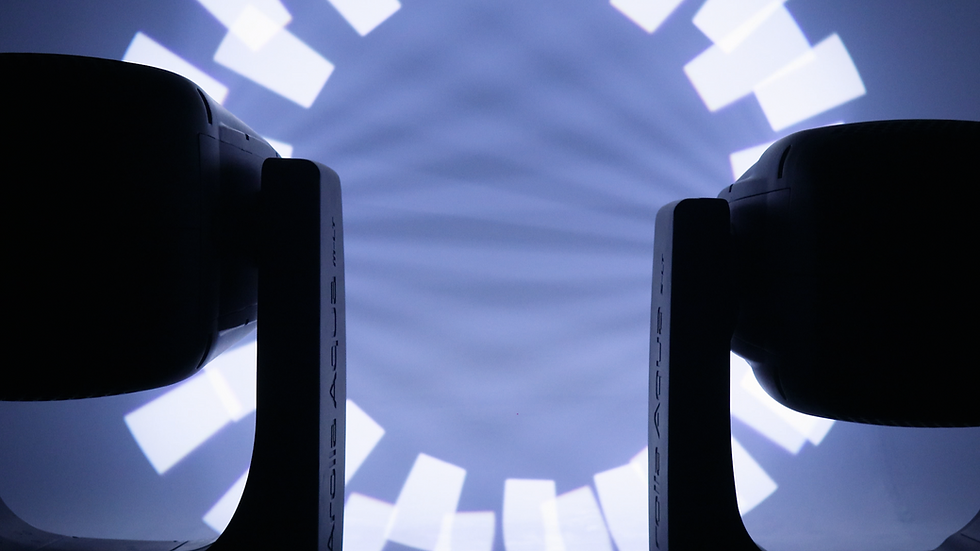
The new B-EYE family was out during our visit. The lineup includes the B-EYE 7, B-EYE 12, and B-EYE K30, bringing RGBL color engines and IP66 protection to the familiar idea of a fixture that can cover wash, beam, and pixel effects.
We also got to see the B-EYE K30 FX. Its dedicated cold white LED layer adds another source to work with alongside the RGBL engine, while two independently rotating lens sections create more ways to build and combine effects. That gives programmers separate white hits to layer into a color look, plus inner and outer lens sections that can run at different speeds or in different directions.
Seeing the finished fixtures running naturally leads to another question: how much work does it take to get all of that into a product that can leave this room and go on the road?
Behind the Scenes in Research and Development
We got access to Claypaky’s Research and Development Center, where that question becomes a lot more tangible. Our visit included a look at indoor stress testing and an outdoor test area on the roof, with fixtures exposed to the elements.
The engineering challenge keeps growing as we ask more of moving lights. More output creates thermal demands. Faster movement puts more importance on the mechanics. Outdoor use introduces environmental conditions that a fixture has to accommodate while continuing to perform.
From Components to Finished Fixtures
Claypaky carries out part of its manufacturing at its Italian headquarters, and our tour gave us a look at the components, assembly work, and quality control handled there. Seeing those stages up close adds another layer to products we normally encounter fully assembled and ready to patch.
A moving light packs a lot into a relatively small space. The optical path has to coexist with motors, electronics, cooling, and the structure supporting it all. Assembly and quality control have to make that combination work consistently across the units that eventually end up together in a rig. Small differences become very visible when everything is asked to do the same thing at the same time.

One of the coolest details we saw was the original mold for the classic Sharpy color wheel. A lot of us have spent considerably more time selecting those colors than thinking about how the wheel was made. Seeing the tooling behind such a familiar component connects the manufacturing process directly to something we have used at the console.
Leaving Bergamo With a Different View
We spend a lot of time talking about what a fixture can do. Visiting Claypaky gave us a better sense of the work that allows it to do those things, and of the people and place behind the brand. After fifty years, there is plenty to look back on, and we also got to see where the next products are being developed.


Comments