


Claypaky B-EYE Family First Impressions: The Iconic Wash Gets a Full Rebuild
Before every manufacturer had a moving head with a face full of individually controlled lenses, there was the B-EYE. When Claypaky introduced the original K10 and K20 more than a decade ago, the idea of a wash light that could pixel map, spin its front lens array into kaleidoscopic eye candy, and still throw a proper beam felt like a stretch. Then every rig in the world seemed to have a row of them.

That kind of legacy cuts both ways. A fixture that iconic can coast on its name for a while, but the market does not wait forever. Claypaky has rebuilt the entire family from the LED up; and the lineup introduces a shared RGBL engine, IP66 protection, and new movement capabilities across three distinct formats.
The New Claypaky B-EYE Multilens Family
Everything in the B-EYE Multilens Family runs on the same 55W RGBL source, red, green, blue, and lime, and that shared engine is the whole point. Lime pushes the gamut wider than the old RGBW arrays could reach, fills in the pastels, and gives Claypaky a cleaner white to calibrate against, with a CRI above 82 for anyone who has a camera pointed at the stage. Every member of the family carries an IP66 rating as part of Claypaky's Shield Family. The fixtures are fully sealed against dust and heavy water jets, and each one gets Claypaky's Sun Safe Protection System, which automatically repositions the head on signal loss to protect the optics.

The third pillar is the effects layer. The programming side remains central to the B-EYE identity. Every RGBL source is individually controllable, with pixel mapping and multi-layer color effects providing the foundation for chases, split-color looks, and more detailed visual content. These are still wash fixtures, but treating the entire head as a single color is only the starting point.
Claypaky B-EYE 7 and B-EYE 12
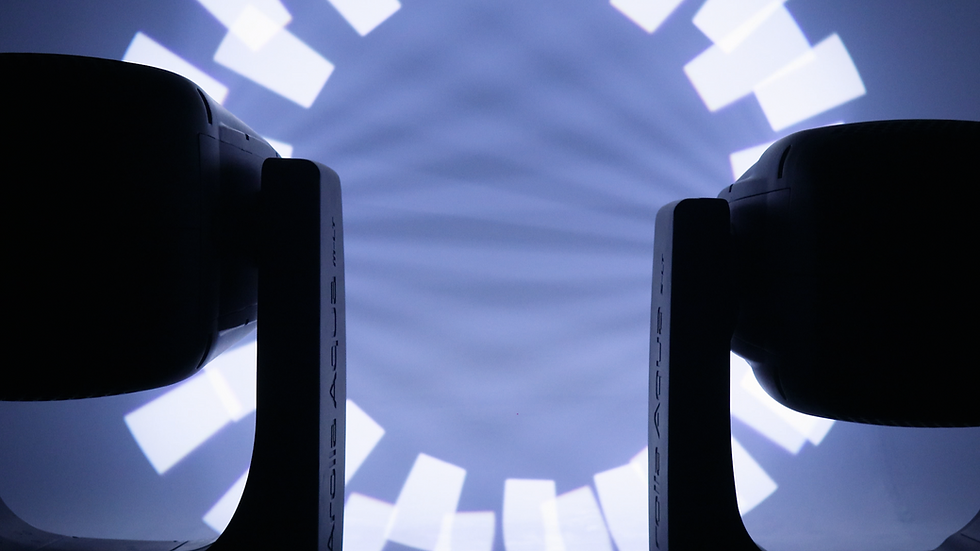
The two smaller fixtures are the workhorses of the range, and they share almost everything except scale. The B-EYE 7 packs seven of those 55W RGBL sources behind a 177 mm front lens for up to 7,700 lumens, with a zoom running from 4 to 45.4 degrees. The B-EYE 12 steps up to twelve sources behind a 215.7 mm lens, up to 15,200 lumens, and a 3.8 to 51.1 degree zoom. Both get the new movement architecture, which means endless pan and endless tilt. The front of each fixture is a dual-glass anti-condensation panel, which is a smart way to handle the IP66 problem on a compact head without adding an active heating system.
The 7 is very, very compact. The first thing we did at was pick one up, and at 12 kg it is genuinely a one-hand fixture with a serious pixel wash inside it. Small stages, corporate rigs, and the edges of festival structures where weight and truss space are tight are going to see a lot of these.

Claypaky positions the B-EYE 12 as the mid-size wash that anchors the whole rig, with output that cuts through haze and can wash a stage. The array on the 12 is the detail that caught our eye, though. There is no central diode. The twelve sources sit in a ring rather than the traditional center-plus-rings layout, and for pixel programmers that changes the geometry. It is the only fixture in the family built this way, and we kinda like it. A perfect centerline with nothing in the middle means symmetrical effects that split cleanly left to right and top to bottom, and radial chases that do not have to account for a hub pixel. It is a small decision that gives the 12 its own personality inside a range that is otherwise deliberately uniform.
Claypaky B-EYE K30
The K30 is the flagship and the direct descendant of the K20 and K25 that made the name. Claypaky calls it a complete re-engineering, and that holds up. The lens array is 37 individually driven 55W RGBL sources behind a 330 mm front lens, good for up to 28,000 lumens, and the zoom runs from 3.7 to 54.5 degrees. That gives the K30 both the tightest and the widest optics in the family, which is fitting for the fixture that covers the biggest stages.

The K in the name still stands for kaleidoscope. Bi-directional infinite rotation of the front lens array is back, and with 37 pixels feeding it, the layered eye candy looks are as dense as ever. Claypaky frames the K30 as three fixtures in one, wash, beam, and kaleidoscopic FX, and the Advanced Layers Management handles the transitions between modes without a gear change. Pan is endless here as well, and a dedicated tilt brake locks the head after power-down whether the fixture is hung or floor mounted.
Where the smaller fixtures rely on passive dual glass, the K30 gets DryCore, an active defogging system that uses controlled airflow and heating elements to keep the front glass clear in cold or humid conditions. Anyone who has watched an outdoor rig fog over during a damp early load-in will understand why that matters on a 37-pixel wash. Claypaky also swapped the K25's linear actuator for a stepper motor-driven zoom, put individual heat pipes on every LED, and made the driver boards accessible in fewer than 20 screws. At 37.6 kg, it is a big fixture, but it is built to be serviced on the road rather than sent home.
Learn More About The New Claypaky B-EYE Multilens Family
Our first impression is that the new B-EYE Multilens family offers three different reasons to pay attention: the compact format of the 7, the pixel arrangement of the 12, and the larger-scale kaleidoscopic capabilities of the K30.
The B-EYE built the category, and this generation is Claypaky's argument that it still owns it. A shared RGBL engine with real cross-fixture color consistency, IP66 across the board, some element of endless motion on every model, and a three-size lineup that scales from a 12 kg compact to a 28,000 lumen flagship.
Full specs, data sheets, and the press kit are on Claypaky's website.


Comments