


Inside USITT 2026: The Student-Driven Show Shaping the Future of Live Production
- Mar 23
- 4 min read
USITT, short for the United States Institute for Theatre Technology, is an annual conference and trade show centered on theatre design, production, and technology. It brings together students, educators, emerging professionals, and working practitioners across disciplines like lighting, sound, scenic, costumes, stage management, and technical production. More than just a place to see gear, USITT is built around learning, connection, and career development, which gives it a very different energy than a show floor built primarily around product launches.
USITT 2026, held in Long Beach from March 18–21 with the Stage Expo open March 19–21, was a strong reminder of why that matters. The event is structured to support people who are still building their path into the industry, with portfolio reviews, professional development, hands-on labs, educational sessions, and an expo floor that invites attendees to ask questions and get close to the tools. That student-first focus is a big part of what makes USITT valuable. In Long Beach, it was clear that the event is not just about showcasing technology, but about helping the next generation understand how this industry works and where they fit into it.

Sessions That Stood Out at USITT 2026
Our session, Building Your Brand: Social Media & Identity for Emerging Designers and Technicians, brought together Gabrielle Camassar, Jasmine Lesane, and Bryan Matthews, each contributing a different perspective. Instead of pushing the usual advice around posting more or chasing algorithms, we broke down what it actually means to present your work in a way that builds long-term opportunity. The reality is that visibility today is tied to perception, and some of the strongest work in a room doesn’t always translate to a phone. Bridging that gap is where a lot of early careers either gain traction or stall, and the discussion centered on how to approach that intentionally without losing authenticity.
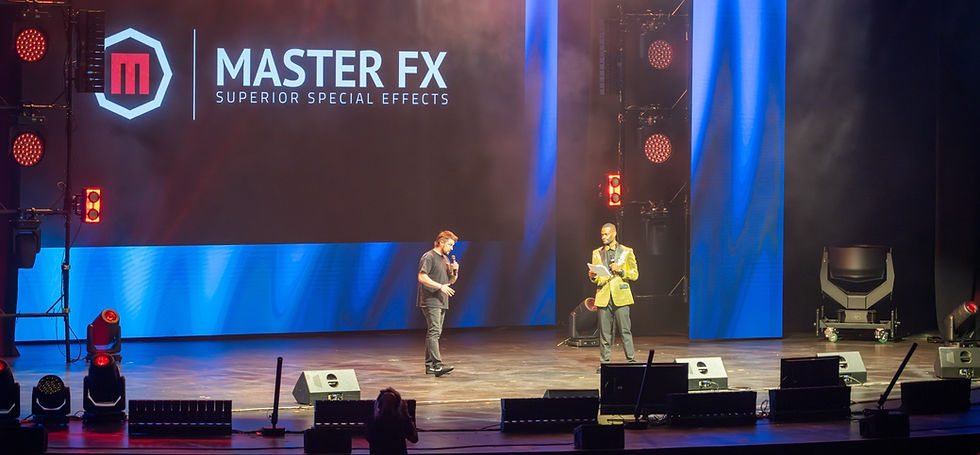
Master FX presented Getting Creative with Special FX also delivered exactly the kind of practical, application-first learning that USITT does well. Instead of treating effects as a catch-all category, the session focused on the tools themselves—haze, fog, low fog, and related atmospheric looks—and the science behind how those effects are created. For students, that kind of understanding is invaluable. Knowing that something looks good is one thing; knowing why one effect behaves differently from another, and which option is the best fit for a specific venue or cue, is what actually leads to smarter design choices.
Innovative Intensity’s Lighting Beyond the Black Box: Designing for Non-Traditional Performance Spaces, led by Mike Berger, hit on a challenge that is only becoming more relevant. As more performances move into found spaces, immersive environments, and venues that were never designed to support traditional theatrical workflows, lighting designers are being asked to adapt quickly. This session pushed beyond aesthetics and into problem-solving, looking at how sightlines, infrastructure, rigging, control, and audience experience all shift when the room stops behaving like a conventional theatre.

4Wall’s USITT Fixture Showcase was another highlight because it framed gear comparison the way working designers actually think about it. Working with lighting designer Sohail Najafi, 4Wall put seven fixtures from seven manufacturers in the same room under the same conditions and built the conversation around real-world tradeoffs: output versus color quality, zoom range versus noise floor, IP rating versus weight, and how those decisions change depending on whether the application is theatre, touring, or broadcast. That made the showcase more than a demo. It became a genuinely useful lesson in how different platforms earn their place in a rig.
Gear We Saw on the USITT 2026 Show Floor
On the show floor, Claypaky’s Arolla Aqua SLT and MLT stood out as fully featured IP66 moving heads with serious output and strong optics. Claypaky positions both fixtures as high-performance, road-ready tools, and that came through clearly. What made them especially interesting from a design standpoint was the flexibility built into the system, including interchangeable gobos that let designers shape texture and breakup more intentionally instead of being locked into a fixed set of looks. Oh... and infinite pan/tilt 🦾.
GLP’s Wild family also made a strong impression because it reads as a more economical path into the company’s color science without losing the qualities that made the X5 line so compelling. GLP says the Wild series carries iQ.Gamut color technology known from the X5 Series and describes the range as offering an attractive price-performance ratio with consistent build and optical quality. In practice, that makes the Wild family feel like a smart option for users who want strong color mixing and solid quality of light, but with a more budget-conscious entry point than the flagship X5 conversation usually implies.

Robe Lighting’s SVB1 rounded out the shortlist as one of the more playful fixtures in the room. Robe positions it as a compact multisource LED moving light that can deliver punchy beams, soft washes, a central strobe, and strong pixel-mapping possibilities in a single unit. That combination is what made it interesting on the floor. It is not just a fixture that does several things on paper; it is a fixture that feels like it could give programmers enough control to make those layers of functionality actually useful in a show environment.
Why Long Beach Mattered
The biggest takeaway from USITT 2026, though, had less to do with any single fixture or session and more to do with what the event continues to offer the industry as a whole. Long Beach felt like a reminder that students and early-career technicians still need spaces built around learning, experimentation, and access—not just exposure. That is where USITT continues to matter. Next year, the conference moves to Baltimore, with USITT 2027 scheduled for March 17–20.


Comments