


How the Master FX ATLAS Ended Up in Stadiums, Tours, Clubs, and Theme Parks
Working with cryo is always a blast in the moment, but getting it into a show is complicated for a lot of reasons. For years, a massive vertical hit meant accepting everything that came with a traditional cryogenic system. The dewars. The hoses. The jets. The local sourcing. The floor space. The noise. The safety considerations. The effect is amazing, but the system behind it does not fit every production. Master FX built the ATLAS to deliver the look without the baggage.

Why Crews Started Paying Attention To The Master FX ATLAS
The engineering problem was straightforward to state and hard to solve: produce a tall, dense, fast-dissipating column from a box that can ride in a floor package. The finished machine fits 30 10-watt RGBAW LEDs and a fog system capable of adjustable plumes up to 50 feet into a 19-by-14-by-9-inch housing. That puts the core effect into a compact package rather than spreading it across a jet, tanks, and the plumbing between them.

The numbers that matter to a crew are the operational ones. A 12-minute warm-up fits inside even the tightest changeover. A continuous burst of up to 20 seconds outlasts what most crews get from a conventional CO₂ tank before pressure falls off. And after the hit, the ATLAS recovers and is ready to fire again without anyone swapping an empty cylinder and reconnecting a line. On a show with repeated effects or tight cueing, that turnaround changes how often the effect can realistically be used. Fluid consumption sits at four milliliters per second at full output, and Master FX developed its APEX fluid specifically for the ATLAS heater core: dense, quick to dissipate, clean and dry, and residue-free. That matters when the effect is firing repeatedly around scenery, LED walls, attractions, or camera positions.
A More Consistent Effect Outdoors
Outdoor events introduce another variable for traditional cryo: the weather. Humidity and other atmospheric conditions can dramatically change how a CO₂ plume looks, meaning an effect that appears thick and defined during one show can look noticeably different the next day, or even later that same afternoon.
ATLAS gives crews more consistency because the effect is generated from fog fluid rather than relying on atmospheric moisture to make the plume visible. Master FX also developed their APEX fog fluid specifically for the system, dialing in the density, hang time, and dissipation needed to create that fast cryo-style hit. For festivals, sporting events, theme parks, and other outdoor applications, that means the effect is far less dependent on what the weather decides to do that day. You can program the hit knowing it is going to look much closer to the same effect show after show.

When The Whole Show Has To Clear The Field
Halftime shows make that integration advantage especially easy to understand. Take the Los Angeles Rams' halftime performance with The Chainsmokers at SoFi Stadium, supplied by RKDE. In this environment, the effects package has to fit into the same deployment plan as the stage: get into position, deliver the show, and clear the field. ATLAS can travel with the scenery without also requiring space for a dewar or a high-pressure hose run back to a separate gas source.
The same logic applies to NBA All-Star player introductions, where we've seen ATLAS' deployed by Advanced Entertainment Services. The creative brief calls for repeated, well-timed hits, while the production brief calls for equipment that can clear the court before play. The ATLAS fires again and again without a reset between hits, and because the units were integrated into intro set pieces that rolled on and off the court, the entire effect cleared the floor with the scenery. No cylinder inventory courtside, no residue on the hardwood.
Taking The ATLAS Advantage On Tour
On tour, that same advantage has to hold up city after city. A tour loads in and out every day, and anything that needs local sourcing in each market is a liability. CO₂ means a dewar delivery in every city, a hose run across every deck, and a pressure test before every show. This year we've seen Pyrotenico integrate ATLAS into moving scenic elements on the Don Toliver Tour so the effect became part of the staging rather than an add-on rigged, plumbed, and tested separately in every city.


Media: @georgelyons__ @brennanadams_ @thahumbleking @jaskarnbola @sinnerthesniper @blazejzalewski @isamariecreative @lagfilm_
Variable output is what makes that kind of integration work in rooms of different sizes. The effect is never all or nothing, so the plume can be scaled to the venue, the cue, or the camera shot, from a full-height hero hit in an arena to a shorter accent that will not overpower a theater. The integrated LEDs handle the other touring problem. A white atmospheric effect can vanish against a bright video wall or go unreadable under a heavily saturated look. ATLAS places its 30 RGBAW emitters directly around the output, so the plume becomes part of the lighting programming and can match the palette of the scene, contrast against it, or shift color through a sequence. For touring shows and broadcast work alike, that is the difference between an effect the audience sees and one it does not.

ATLAS for Usher's 2024 Super Bowl Halftime Show, provided by Pyrotecnico
Building The Effect Into The Venue
The last step was permanence. If ATLAS could live inside a rolling stage or a piece of touring scenic, it could live inside a building, and that is where CO₂ is hardest of all to manage. A venue that runs the effect night after night does not want tank deliveries, and an attraction that runs it hundreds of times a day with no operator standing by cannot have them.
Radius Chicago is the club application of that story. A kit of ATLAS units have earned their way into the house rig and are used in a variety of ways for each visiting act. Master FX has also expanded what a single ATLAS can do. The Array Attachment Kit, which debuted at LDI 2024, replaces the original nozzle with dual- or triple-output versions, so one machine can throw multiple smaller geysers rather than a single central plume. Each kit contains two dual-output and two triple-output nozzles, and the swap is fast and easy, requiring only a 12-millimeter socket.
Attractions take the integration challenge further. Once an effect is concealed within a ride or installed somewhere difficult to access, how it gets supplied and monitored becomes just as important as what comes out of the nozzle. At Knott's, Master FX designed a system that automatically triggers an ATLAS at specific points within a ride, fed by a 200-foot fluid distribution network. ATLAS units now run at Knott's Berry Farm, in Disney attractions, on cruise ships, and in other permanent installations where reliability and repeatability matter as much as the size of the effect.
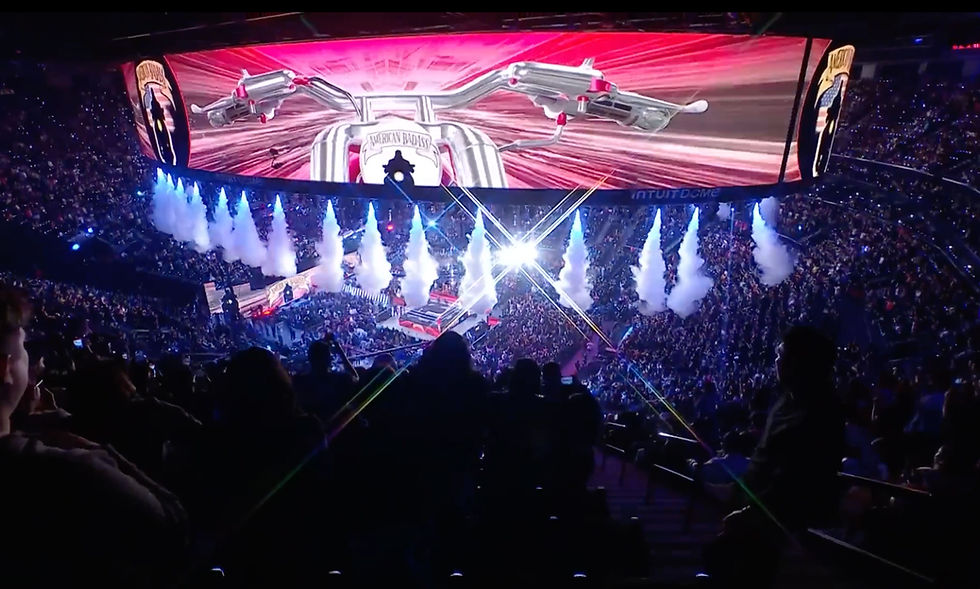
For projects like these, Master FX does more than supply machines. The company develops custom installation systems around its products, including specialized mounting, automated fluid distribution, remote monitoring, sensor triggering, and centralized control. The Halo Board at Intuit Dome is the clearest example, where 40 ATLAS units were integrated into the scoreboard and positioned to fire downward toward the crowd. The installation, developed in collaboration with Image Engineering, required custom hardware and an automated system capable of keeping every unit filled, monitored, and ready to fire. An effect that started as a way to get cryo off the sideline is now built into the architecture of the building.
Master FX ATLAS II Preview
Keep an eye out for the ATLAS II, previewed at LDI 2025 and now on the horizon. Rather than replacing the original ATLAS, ATLAS II joins it as the bigger brother in the lineup, stepping up to 44 10-watt RGBAW LEDs arranged in a wider array for more output and broader coverage. It also adds precise start-and-stop control and a weather-ready, waterproof design. The original ATLAS is not going anywhere, but ATLAS II gives productions another option when the application calls for an even bigger effect.

Comments